Strength & Muscle
Progressive Overload Explained for Beginners
Learn how beginners can progress through weight, repetitions, sets, technique, range of motion, and consistency without overcomplicating training.
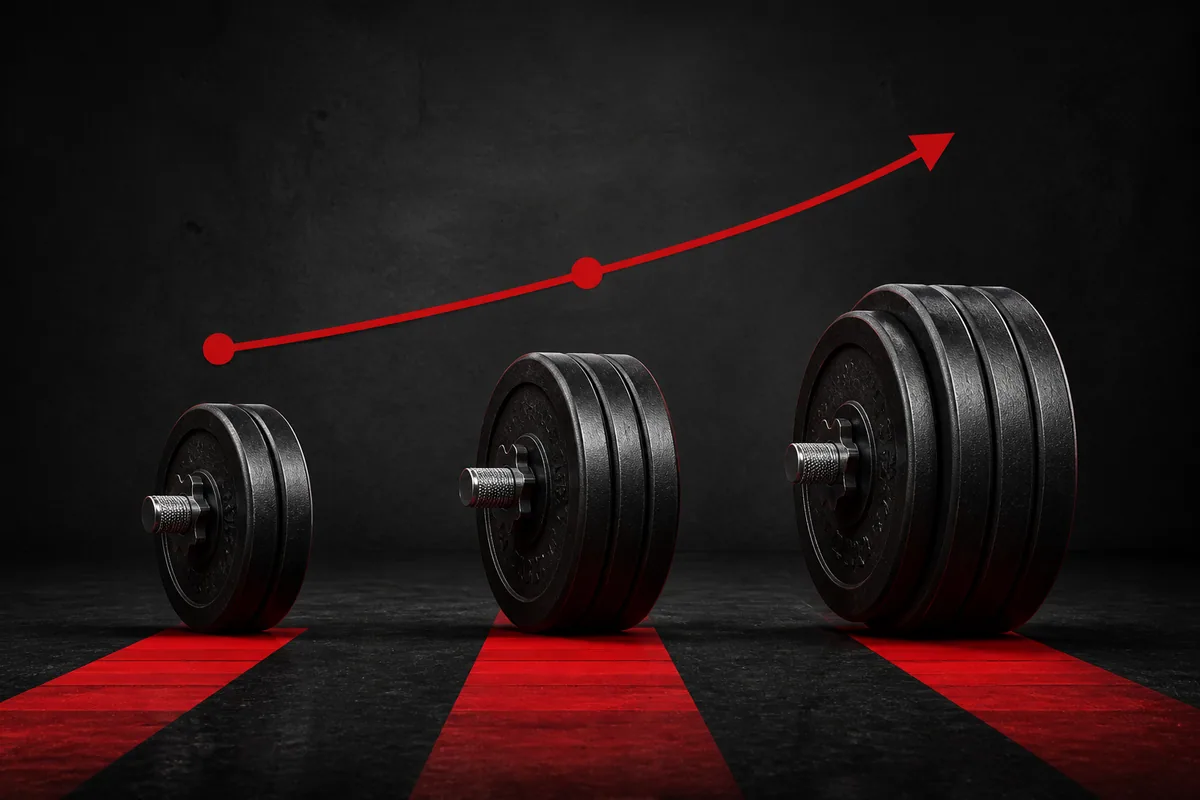
When you first start working out, almost any consistent training can feel challenging.
But eventually, the same workout that once felt difficult starts becoming easier.
That is a good thing.
It means your body is adapting.
The next question becomes:
How do you keep making progress?
That is where progressive overload comes in.
It sounds technical, but the idea is actually simple.
What Is Progressive Overload?
Progressive overload means gradually increasing the challenge your body has to handle over time.
Your body adapts to the demands you consistently place on it.
If those demands never change, eventually there is less reason for your body to continue adapting.
So as you become stronger and more capable, your training should gradually progress with you.
That does not mean every workout needs to be harder than the last.
It means that when you look at your training over time, something should gradually be improving.
Current ACSM resistance-training guidance emphasizes regular participation, effort, and matching training variables such as volume and load to your individual goals rather than chasing an unnecessarily complicated program.
Progressive Overload Is Not Just Adding Weight
This is probably the biggest misunderstanding beginners have about progressive overload.
People hear the word overload and assume:
I need to lift heavier every workout.
Not necessarily.
Increasing weight is one way to progress.
But it is not the only way.
You can also progress by:
- Performing more repetitions
- Performing an additional set
- Improving your range of motion
- Improving your exercise technique
- Controlling the movement better
- Performing a more challenging exercise variation
- Increasing your total training volume
- Performing the same work with better quality
Especially when you are new to training, improving your technique can be just as important as increasing the number on the dumbbell.
A Simple Progressive Overload Example
Imagine you are performing dumbbell curls.
You begin with:
At first, those final repetitions are challenging.
After several weeks of consistent training, you can now perform:
That is progress.
You may now decide to try:
You did not randomly increase the weight.
You earned the increase by improving with the weight you were already using.
What Is Double Progression?
A very beginner-friendly way to use progressive overload is sometimes called double progression.
Imagine your program gives you a range of:
8-12 repetitions
You choose a weight you can properly control.
Maybe Week 1 looks like:
Over time, that might become:
Once you can consistently reach the top of your target range with good form, you can consider increasing the resistance.
Then your repetitions may drop toward the lower part of the range again.
From there, you gradually build back up.
This creates a simple progression system without forcing you to add weight every session.
When Should You Increase the Weight?
Do not increase weight just because the calendar says another week passed.
Ask yourself:
- Can I perform the current weight with good technique?
- Am I reaching the top of my target repetition range?
- Can I control the weight throughout the movement?
- Does my range of motion remain consistent?
- Am I actually ready for a greater challenge?
If the answer is yes, an increase may make sense.
If adding weight causes your technique to completely fall apart, you probably progressed too quickly.
Remember:
More weight is only progress if you can still perform the exercise properly.
Form Comes Before Load
Let's use curls again.
You may technically get a 30-pound dumbbell from the bottom position to the top.
But if you have to swing your entire torso, throw your hips forward, and use momentum to get it there, you did not necessarily make your biceps stronger through the movement you were trying to train.
Sometimes the better progression is staying with the lighter dumbbell and performing cleaner repetitions.
This connects directly with one of the biggest beginner mistakes we already covered: sacrificing form just to lift more weight.
Do You Need to Train to Failure?
No.
You do not need to make every single set end with the weight becoming physically impossible to move.
Training should create an appropriate challenge, but advanced techniques are not automatically necessary for general fitness or muscle growth.
ACSM's 2026 review found that techniques such as intentionally training to momentary muscular failure were not consistently necessary for outcomes in the average healthy adult.
As a beginner, learning to challenge yourself while maintaining good technique is much more useful than trying to destroy every muscle every workout.
Should You Add More Sets?
Sometimes.
Increasing training volume can be another form of progressive overload.
For example:
But again, more is not automatically better.
If you continuously add sets without considering your recovery, eventually you can create more work than you can productively handle.
Training volume should match your experience, goals, and ability to recover.
For muscle growth specifically, current ACSM guidance indicates that higher weekly volume can support hypertrophy, with roughly 10 weekly sets per muscle group presented as an optimization target in the evidence review. That does not mean every beginner needs to immediately perform 10 hard sets for every muscle.
Build gradually.
Track Your Workouts
Progressive overload becomes much easier when you actually know what you did last time.
You do not need complicated software.
Track things such as:
- Exercise
- Weight
- Sets
- Repetitions
Now instead of walking into the gym and guessing, you have a target.
This time your goal might simply be:
Beat one of those numbers while maintaining good form.
Maybe you get 11, 9, 8.
That is progress.
Small improvements add up.
You Will Not Progress Every Workout
This is important.
Progress is not perfectly linear.
Some workouts will be great.
Some will feel average.
Sometimes you may even perform worse.
Your sleep, nutrition, stress, recovery, and other factors can affect your performance.
Do not assume your entire program stopped working because one workout was difficult.
Look at trends over several weeks.
What If You Stop Progressing?
Eventually, everyone reaches periods where progress slows.
Before completely changing your program, look at the basics.
Ask:
- Have I actually been training consistently?
- Am I tracking my workouts?
- Am I getting enough recovery?
- Is my nutrition supporting my goal?
- Am I using good technique?
- Have I been following this program long enough to judge it?
Sometimes you do need a program adjustment.
But sometimes the program is fine and the issue is consistency.
Do Beginners Need Complicated Periodization?
Usually, no.
There are advanced ways to structure training over weeks and months.
Those methods can become useful depending on your goals and experience.
But beginners do not need to turn every workout into a math equation.
ACSM's updated resistance-training recommendations emphasize that consistency and individualized programming matter more for most adults than unnecessarily complex training systems.
Exercise -> Track -> Improve -> Repeat.
You can add complexity when you actually need it.
The Goal Is Gradual Improvement
Progressive overload is not:
Do more at all costs.
It is:
Create an appropriate challenge and gradually become better at handling it.
Sometimes that means more weight.
Sometimes more reps.
Sometimes better form.
Sometimes better range of motion.
Sometimes simply becoming more consistent.
You are building fitness over time.
Give yourself time to build it.
New to Training?
Start with How to Start Working Out: A Beginner's Guide.
Then read 7 Common Beginner Workout Mistakes That Can Slow Your Progress and How Often Should a Beginner Work Out?.
These articles create the foundation that progressive overload builds on.
Sources & Further Reading
- ACSM Unveils Landmark 2026 Resistance Training Guidelines, American College of Sports Medicine