Strength & Muscle
Why You're Working Out but Not Gaining Muscle
Training consistently but struggling to build muscle? Learn how progression, nutrition, protein, recovery, training volume, and patience affect muscle growth.

You have been going to the gym.
You are doing the exercises.
You are putting in effort.
But when you look at your progress, you are wondering:
Why am I not gaining muscle?
There usually is not one universal answer.
Muscle growth depends on several pieces working together.
Training matters.
Nutrition matters.
Recovery matters.
And most importantly, those things have to happen consistently for enough time to produce results.
Let's look at some common reasons your progress may be slower than you expected.
1. Your Workouts Are Not Actually Progressing
Showing up matters.
But eventually, simply repeating the same workout may not provide enough of a new challenge to keep driving adaptation.
Imagine doing:
3 sets of 10 with the same weight
for months.
Same repetitions. Same resistance. Same exercise. Same effort.
At first, that workout may have been difficult.
Eventually, your body adapts.
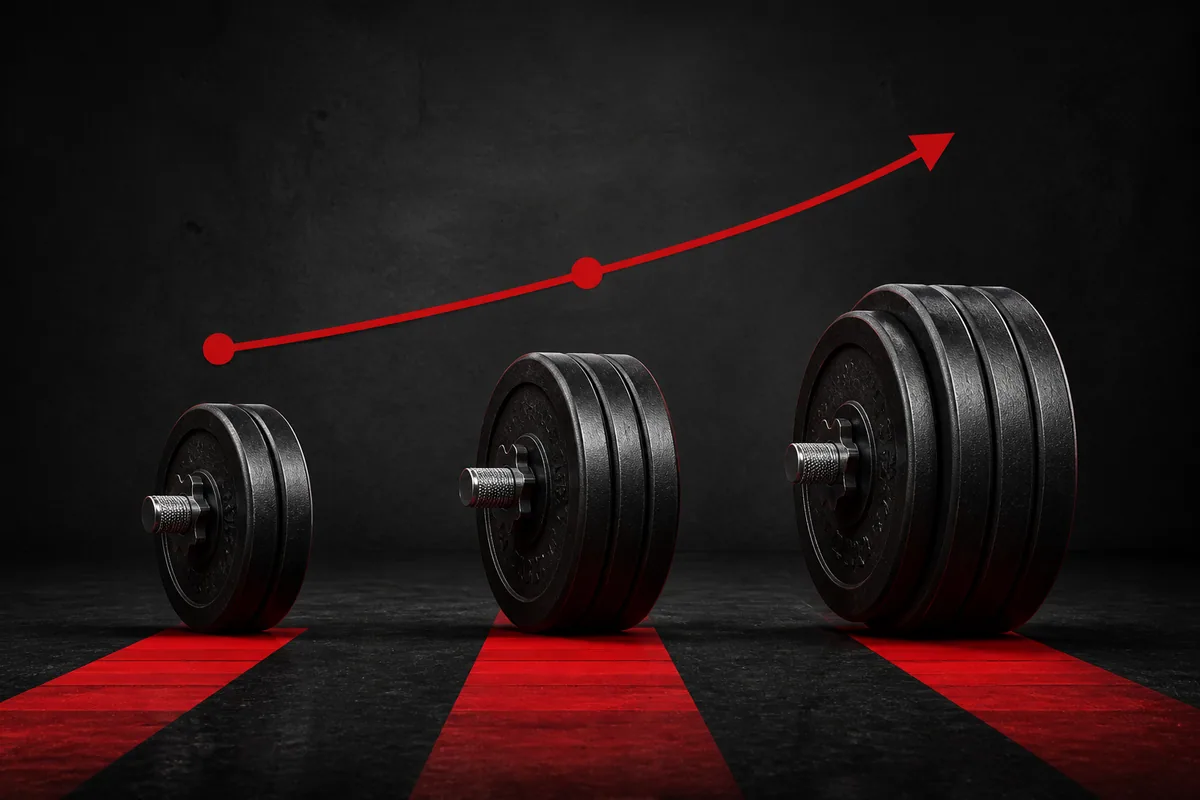
That is why progressive overload matters.
You need some form of gradual progression over time.
That might mean:
- More weight
- More reps
- More sets when appropriate
- Better exercise control
- Better range of motion
- A more challenging variation
2. You May Not Be Doing Enough Productive Training
There is a difference between being in the gym for a long time and performing enough productive resistance training.
Muscle growth requires an appropriate training stimulus.
Current ACSM guidance indicates that resistance-training volume matters for hypertrophy, with higher weekly volume - roughly around 10 sets per muscle group - potentially optimizing muscle growth.
That does not mean everyone needs exactly 10 sets.
And it definitely does not mean a beginner should immediately add as many exercises as possible.
But if you barely train a muscle or perform very little challenging work, there may not be enough stimulus to produce the result you expect.
On the other hand, adding endless sets is not the solution either.
There is a point where more work simply becomes more fatigue.
3. Your Nutrition May Not Support Muscle Gain
You cannot build a muscle-gain strategy around training alone.
Your body also needs energy and nutrients.
If you are consistently eating too little for your needs, gaining body mass and lean tissue can become more difficult.
The ISSN's position stand on diets and body composition notes that diets focused primarily on increasing lean mass are generally supported by sustained energy intake above maintenance, while the exact size and composition of that surplus should depend on the individual and training status.
That does not mean:
Eat everything you can find.
You do not need an uncontrolled bulk.
It means your overall food intake needs to match what you are trying to accomplish.
If your goal is gaining muscle but your body weight is consistently dropping because you are not eating enough, your nutrition may be working against your goal.
4. You Are Not Consistently Getting Enough Protein
Protein provides amino acids your body uses in muscle protein remodeling and growth.
You do not need to become obsessed with protein shakes.
Food counts too.
Examples of protein sources include:
- Chicken
- Turkey
- Eggs
- Fish
- Lean beef
- Greek yogurt
- Cottage cheese
- Milk
- Beans and legumes
- Soy foods
- Other protein-rich foods
For exercising individuals, sports-nutrition position stands generally support higher protein intake than the basic sedentary minimum, and research emphasizes that total daily protein intake is a major consideration.
For a practical breakdown, read How Much Protein Do You Need to Build Muscle?.
5. You Are Too Focused on the Anabolic Window
You finish your last repetition.
Now you feel like you have 20 minutes to find a protein shake before all your gains disappear.
Relax.
Post-workout nutrition can be useful.
But your results are not determined by whether you drank your shake at minute 17 instead of minute 45.
Research reviewed by the ISSN suggests that total daily protein intake is generally a larger priority than obsessing over extremely precise protein timing.
Eat consistently throughout the day.
Make sure your overall nutrition supports your training.
Do not allow small details to distract you from the big picture.
For practical meal ideas around training, read What Should You Eat Before and After a Workout?.
6. You Keep Changing Your Program
If you change exercises every time you see something new online, it becomes difficult to tell whether you are improving.
One week: Dumbbell press.
Next week: Machine press.
Then: Cable press.
Then something you saw on TikTok.
Variety is not automatically bad.
But constantly changing exercises can prevent you from establishing a baseline and measuring progression.
Keep enough consistency in your program to see whether you are becoming stronger and performing better.
7. You Are Not Recovering
Muscle growth does not happen because you trained chest seven days in a row.
Training creates the stimulus.
Recovery is part of how you adapt to it.
Recovery includes:
- Sleep
- Rest between training sessions
- Nutrition
- Hydration
- Managing overall training volume
- Managing stress where possible
You do not need to avoid effort.
You need to balance effort with enough recovery to continue performing.
If every workout leaves you completely destroyed and your performance keeps getting worse, adding more training may not solve the problem.
8. You Expect Visible Changes Too Quickly
Muscle growth takes time.
The first few weeks of a new program may produce improvements in:
- Exercise technique
- Strength
- Coordination
- Workout confidence
- Training capacity
before you notice dramatic visual differences.
Do not allow social media transformations to distort your expectations.
You rarely see every ordinary training day between the before picture and the after picture.
Give the process enough time.
9. You Are Only Using the Mirror to Measure Progress
Your appearance matters if body transformation is your goal.
But the mirror should not be your only measurement.
Track:
- Body weight
- Progress photos
- Measurements when appropriate
- Workout performance
- Repetitions
- Resistance
- Exercise technique
- Training consistency
If your body weight is gradually moving in the intended direction and your performance is improving, those can provide useful information even before dramatic visual changes happen.
10. You Might Be Training Hard - But Not Consistently
Three great workouts followed by two weeks off is not the same as months of consistent training.
Consistency can feel boring.
But boring works.
ACSM's latest resistance-training position stand emphasizes that moving from no resistance training to regular resistance training produces meaningful benefit and that consistent participation matters more than chasing a supposedly perfect, complicated program.
You need enough repeated training for your body to adapt.
What Should You Focus on?
Train consistently.
Follow a structured resistance-training program.
Progress your training.
Give your muscles an increasing challenge over time.
Eat enough.
Your total energy intake needs to support your goal.
Get enough protein.
Make protein a consistent part of your overall diet.
Recover.
You cannot separate progress from recovery.
Track what you are doing.
Do not rely entirely on memory.
Give it time.
You are building tissue.
Not downloading an update.
When Should You Change Your Program?
Do not change your program because you had one bad workout.
Consider adjustments when you have followed the program consistently for enough time to evaluate it and you have a real reason to change something.
Maybe:
- Progress has genuinely stalled
- Your schedule changed
- Your goals changed
- Certain exercises no longer fit your situation
- Your available equipment changed
- Your recovery needs changed
Make adjustments intentionally.
What If You Are Doing Everything Right and Still See No Progress?
If you are consistently training, eating appropriately for your goal, recovering, and tracking progress but something still seems significantly off, there may be factors outside the scope of general fitness coaching.
A qualified healthcare professional or other appropriate professional may be able to help if you are concerned about unexplained changes in weight, energy, appetite, performance, or health.
Do not self-diagnose based on a fitness article.
Keep the Big Picture Simple
Building muscle requires patience.
You do not need a secret exercise.
You do not need a magic supplement.
You need enough productive resistance training.
Enough nutrition.
Enough recovery.
Progression.
Consistency.
And time.
Continue Learning
Read Progressive Overload Explained for Beginners and How to Start Working Out: A Beginner's Guide.
If you are still struggling with your weekly schedule, also see How Often Should a Beginner Work Out?.
Sources & Further Reading
- ACSM Unveils Landmark 2026 Resistance Training Guidelines, American College of Sports Medicine
- International Society of Sports Nutrition Position Stand: Diets and Body Composition, Journal of the International Society of Sports Nutrition
- International Society of Sports Nutrition Position Stand: Protein and Exercise, Journal of the International Society of Sports Nutrition